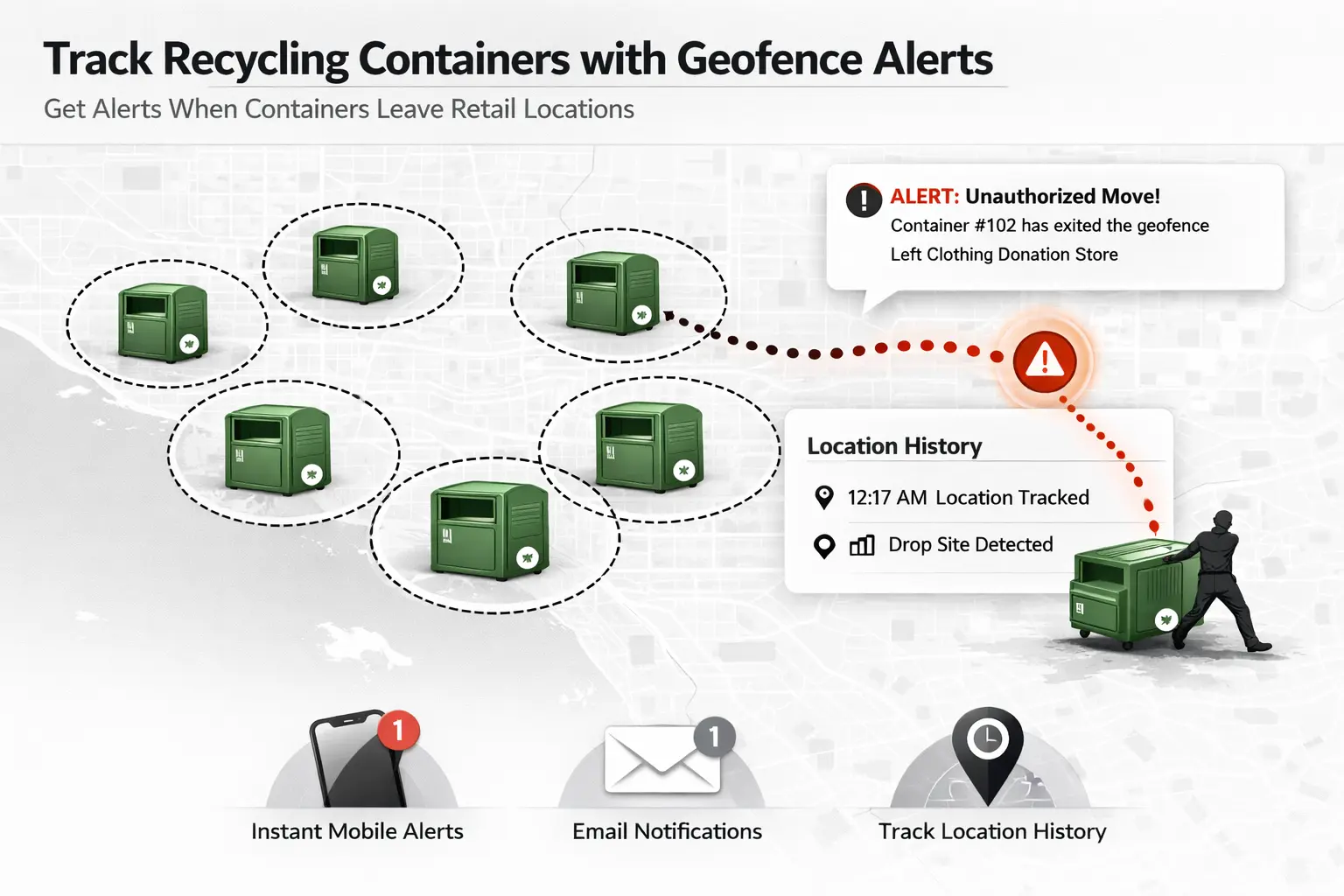
Theft and Competitor Poaching
Bins in open retail lots get stolen for scrap metal or physically replaced by competitors. The recovery window is 12-24 hours before a steel bin is crushed at a scrap yard.
Industry
Operators lose 10–15% of deployed bins yearly to theft, vandalism, and unauthorized moves. TagLogger detects container movement so teams respond before a write-off.
Containers in retail lots and host sites face theft, competitor poaching, and unauthorized removal. Each missing bin bleeds revenue daily, disrupts haul schedules, and can trigger municipal code violations. Traditional GPS tracking is too expensive for large non-powered fleets.
Bins in open retail lots get stolen for scrap metal or physically replaced by competitors. The recovery window is 12-24 hours before a steel bin is crushed at a scrap yard.
Traditional GPS runs $10-25 per container per month in cellular fees alone. For a 500-bin fleet, that's $60K-150K per year before the platform subscription.
Without geofence alerts, operators don't learn a bin is missing until the next scheduled route visit - days or weeks later, when recovery is no longer realistic.
More municipalities now require bin registration, permitted placement, and visible operator identification. A bin moved to an unpermitted location creates code violations the operator is liable for.
Industry context: NACTR bin operator standards, New Jersey donation bin law, Ottawa donation box by-law, ReMA/ISRI Stop Metals Theft program.
Track, replay, and geofence your fleet on a real map, then export proof and alert your team where they already work.
See live placement of tags across your operating region with a current-location list for quick visibility.
The moment a tag crosses a zone boundary, TagLogger fires an entry or exit alert. And when an asset is away from a zone longer than expected, TagLogger reminds you. Alerts reach your phone and the tools your team already runs on.
Entries, exits, and assets away longer than expected, delivered in real time across every channel
Adjust boundaries to fit your operation, from tight on-site zones to broad regional coverage.
Set zone radius to fit any site or region
Powered by 2 billion+ Apple devices with no hidden cellular fees.
Global coverage through the Find My network
Track the latest entry/exit and movement events in one feed for faster response.
Auto-populated feed with no setup required
Create secure share links with optional expiry and revoke controls for location sharing.
External access without account login
Export CSV or JSON records for proof of delivery, audits, insurance claims, and reporting workflows.
Exports include route points and timestamps
Generate a branded one-page proof-of-location report or a full activity report as PDF, with honest accuracy and travel estimates surfaced as reported.
One-click branded PDF with a document fingerprint
Switch route history to a density heatmap to instantly see where a tag spends the most time.
Surface dwell hotspots at a glance
Access crisp, high-resolution satellite views for sharper detail and better visibility in the field.
High-resolution satellite basemap on demand
Give teammates view or change access for all tags or selected tags.
Role-based access with per-tag visibility
Build custom integrations with REST endpoints, signed webhooks, and drop-in Python and TypeScript SDKs, backed by a published OpenAPI 3.1 spec.
Scoped, revocable API keys
View API documentationPublish white-label pages under your brand that give each customer a live view of their tags, zones, and recent zone activity.
One secure link per customer, revocable anytime
Create geofence zones in bulk from a CSV file, with a preview before anything is created.
Bulk zone setup from one spreadsheet
Everything above comes standard.
One plan with every feature included. No tiers to compare, nothing to unlock later.
Recycling and donation containers sit in retail lots and host sites - high-visibility, low-supervision locations. Bins get stolen for scrap metal, relocated by competitors, or removed by property management without notice. A single missing bin costs $200-500 per month in lost collections and $1,500-3,000 to replace.
Without reliable tracking, the operator often doesn't learn a bin is gone until the next scheduled route collection - days or weeks later. By then, recovery is unlikely and the revenue is lost.
2B+
Find My Coverage Footprint
Coverage built on the Apple Find My ecosystem used by AirTag hardware.
Up to 6 years
Battery Option
Extended Tag hardware supports long-life deployments in outdoor container environments.
Recovered
Container Recovery Focus
Geofence and movement history improve the response window when bins move off-pattern.
Non-powered outdoor containers rarely justify traditional GPS economics. Here's how a 500-bin fleet looks side by side, with one-time hardware and recurring service on both sides.
| Cost dimension | TagLogger (sealed tag) | Traditional GPS tracker |
|---|---|---|
| Hardware per container | $20–$30 | $80–$200 |
| Recurring service per container | $10/month, no SIM | $10–$25/month cellular |
| 500-bin fleet, Year 1 hardware | $10,000–$15,000 | $40,000–$100,000 |
The Apple Find My network provides coverage in the suburban and urban retail corridors where bins are typically placed — the same locations with the highest iPhone density.
Start with high-risk container clusters near retail corridors, assign alert ownership, and set geofence standards by site type. Once workflows are proven, expand region by region with the same operating playbook.
Cellular GPS works for waste and recycling containers — and it's been the default for the operators who can afford it. The unit economics are also why most operators can't afford it. A cellular GPS module on a non-powered container runs $80–$200 in hardware, $10–$25/month in cellular fees, and requires a battery swap or recharge every few months because the module is the only thing drawing power. For a 1,000-container fleet, that's $80K–$200K in hardware plus $120K–$300K/year in recurring service before maintenance labor.
The TagLogger TCO on the same fleet runs differently. Hardware is $20 per Standard Tag or $30 for the Extended Tag (the right pick for outdoor unattended deployments). Service is $10 per tag per month, billed annually, with no per-container cellular contract. The Find My relay ride-along means there's no on-container power budget eaten by cellular radio — the tag transmits BLE for milliseconds when an Apple device is nearby, then sleeps.
| Cost line | Cellular GPS (1,000 containers) | TagLogger Extended Tag (1,000 containers) |
|---|---|---|
| Hardware (year 1) | $80,000–$200,000 | ~$30,000 (Extended Tag) |
| Recurring service (year 1) | $120,000–$300,000 (cellular) | $120,000 ($10/tag/month) |
| Battery / power maintenance per year | Multiple swaps or charge cycles per unit | Effectively zero — Extended Tag rated up to 6 years |
| 3-year cumulative cost | $440,000–$1,100,000 | ~$390,000 |
The trade-off is real and worth naming. Cellular GPS gives you continuous reporting independent of foot traffic. TagLogger gives you near-continuous reporting wherever Apple devices show up — which for retail-lot containers, transfer stations, and route stops is essentially everywhere. Containers parked deep in remote rural areas with no Apple-device foot traffic for days at a time are the exception, and for those a cellular GPS layer still wins. The math on most fleets favors a hybrid: cellular GPS on the few units in genuinely remote rotation, TagLogger on the bulk fleet.
Last-seen context helps teams prioritize recovery actions when containers are reported missing or moved unexpectedly.
Movement history supports customer and municipal follow-up with evidence instead of phone-chain reconstruction.
Geofence workflows help operations detect off-pattern movement and execute repeatable escalation steps.
Three tags, one platform. Every tag ships pre-configured and reports into the same dashboard, so you only choose the size and battery life that fits where it will live. If you already own compatible Find My tags, we can onboard those instead.
Slim coin-cell tag for tools, cases and equipment where size matters most.
Sealed multi-year tag for vehicles, trailers and equipment that lives outdoors.
Twin lithium cells for the longest deployments with the fewest site visits.
All three shown at the same scale.
Deploy geofence-based monitoring and shared location history for faster theft response and stronger operational control.