Hospital operations
Cares about utilization and flow. Their precision threshold is "which department" — not "which bay." They need to know which wing.
Medical Equipment Tracking
A procurement-grade compare on RTLS, BLE-relay, and AirTag-based asset tracking — what each costs at a 200-bed hospital, where each one wins, where each one breaks. For the technical RTLS comparison, see AirTag vs RTLS.
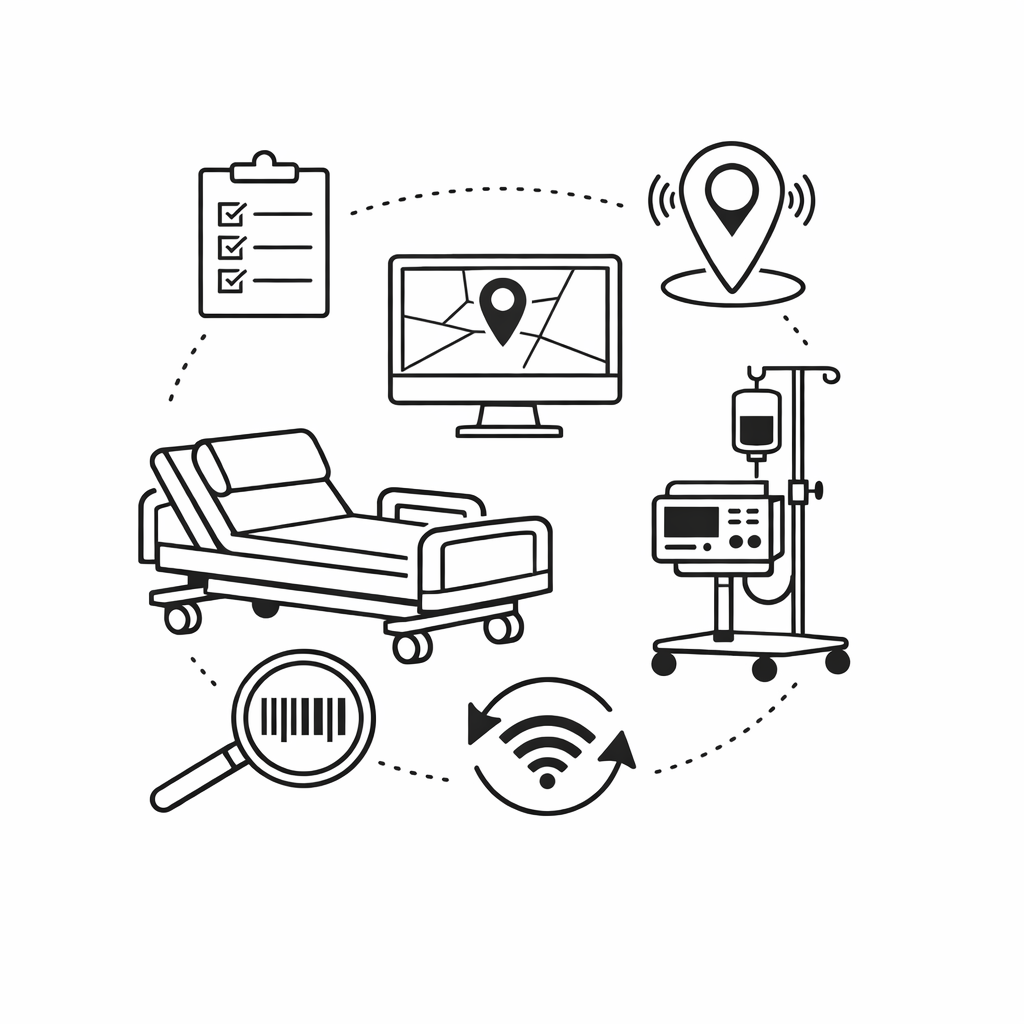
A medical equipment tracking system answers a narrow question: where, right now, is each piece of mobile clinical equipment in the building? The hospital can answer it three different ways, and the right answer depends on how precise the team needs the location to be.
The dominant category for the past 15 years has been RTLS — Real-Time Location Systems. Vendors like CenTrak, Stanley Healthcare AeroScout, Sonitor, and Intelligent InSites install reader and beacon infrastructure throughout the facility and tag every asset with a battery-powered active tag. HIMSS RTLS efficiency research consistently cites reader-network deployments in the $200,000–$500,000+ range per facility before tags or service.
A newer category — BLE-relay — replaces the dense reader grid with a thinner network of ceiling gateways. Cognosos and MOCA Network fit here. Cost falls because there are fewer readers, but accuracy is room-level rather than sub-meter, and most still require some on-site infrastructure.
The third category is the newest: consumer Bluetooth beacons (specifically AirTag) running on Apple's Find My network with a business platform layered on top. There is no infrastructure to install. Accuracy is wing or floor-level. This is the category TagLogger sits in.
The procurement decision is not "which tracking system is best." It is "which precision tier does this hospital actually need, at what budget, for which categories of equipment."
Three departments end up in the same procurement meeting and want different things from the same system. Naming the differences up front prevents a rollout that satisfies one team and frustrates the other two.
Cares about utilization and flow. Their precision threshold is "which department" — not "which bay." They need to know which wing.
Cares about preventive maintenance scheduling and equipment availability for compliance audits. Threshold: "which department, plus a verifiable history record."
Cares about staff time. The HIMSS-cited number is 21-60 minutes per shift hunting for equipment. Threshold: "is the equipment on this unit."
None of the three teams genuinely needs sub-meter precision for the bulk of mobile equipment. The exceptions — and they are real — are infection-control workflows requiring contact-tracing precision in trauma bays, OR-suite case management, and certain workflow optimization use cases inside high-acuity units. Those are RTLS use cases. The other 80% of mobile equipment is not.
| System | Technology | Typical accuracy | Reader / infrastructure cost | Time to deploy |
|---|---|---|---|---|
| CenTrak | RTLS — IR + Second-Gen RFID | Sub-room | $200K-$500K+ per facility | 6-18 months |
| Stanley Healthcare AeroScout | RTLS — WiFi RTT + BLE | 1-3 meters | $100K-$400K per facility | 6-12 months |
| Sonitor | RTLS — Ultrasound + BLE | Sub-room | $200K-$500K+ per facility | 6-18 months |
| Cognosos | BLE-relay — gateways | Zone / room-level | $30K-$150K per facility | 2-6 months |
| TagLogger on AirTag | Apple Find My network relay | 10-30 meters indoors (wing/floor) | None | Hours to days |
The cost columns reflect publicly-discussed deployment ranges from HIMSS case studies, industry analyst reports, and vendor RFP responses. Actual quotes vary by facility size, density requirements, and whether existing WiFi infrastructure can be leveraged.
RTLS is the correct technology for clinical workflows where sub-meter precision is the actual requirement, not a nice-to-have. The honest list: active OR case management, trauma bay equipment positioning during a code, infection control contact tracing where the audit asks "exactly which equipment was in exactly which patient room at this exact time," and high-volume hospital workflow optimization where a few seconds per transport, compounded across thousands of moves a day, materially changes staffing math. For these, RTLS is worth the seven-figure capital cost, and a Bluetooth-beacon platform is not a substitute regardless of price.
An AirTag-based platform like TagLogger is the right choice for the much larger category of mobile equipment that does not need sub-meter precision. Wheelchairs, IV pumps, bladder scanners, portable monitors, transport carts, vital-signs equipment, environmental services equipment, biomed-out-for-PM items, specialty beds, WOWs, crash carts. For "which floor is it on, did it come back to central supply, has anyone seen it in the last 24 hours" — an AirTag-based system answers comfortably at roughly one-tenth the deployment cost and with no infrastructure to install.
The pragmatic answer for many hospitals is both — RTLS in the narrow clinical zones where it earns out, AirTag-based tracking on the bulk fleet where RTLS would be financial overkill. The two layers do not conflict because they ride entirely different signals.
A reference scenario: 200-bed community hospital, 800 mobile assets to track, three-year horizon, mid-range assumptions for each system class.
| Approach | Year-1 infrastructure | Year-1 hardware (800 assets) | 3-year service | 3-year total |
|---|---|---|---|---|
| RTLS — UWB or sub-room class | $250K-$500K | $40K-$120K ($50-$150/tag) | $90K-$200K | $380K-$820K |
| RTLS — BLE mesh class | $80K-$200K | $20K-$60K | $50K-$120K | $150K-$380K |
| BLE-relay (Cognosos-class) | $50K-$150K | $20K-$60K | $40K-$120K | $110K-$330K |
| TagLogger on AirTag | $0 | $12K ($15 × 800) | $288K ($120/tag/year × 3) | ~$300K |
RTLS service costs assume vendor-managed maintenance contracts; some hospitals self-service after year one. The TagLogger figure uses the flat $120 per-tag annual service rate — see /#pricing. The dominant signal: the AirTag-based approach has zero capital infrastructure spend. For multi-campus health systems, this means a tracking program can roll out one campus at a time without amortizing a $300K reader installation against a small initial tag count.
TagLogger gives hospitals wing-level visibility on wheelchairs, pumps, beds, and biomed equipment with no readers, no beacons, and no facility infrastructure to install. Compare a 200-bed deployment against your current RTLS quote.